

The line between a successful quarterly production cycle and a multi-million-dollar catastrophic delay is often thinner than a human hair. For facility managers in Albuquerque’s “Silicon Mesa,” the arrival of a new lithography machine or the relocation of a wafer fab isn’t just a logistical task; it’s a high-stakes precision event. When equipment is sensitive to a single micron of dust or a fraction of a G-force, standard moving protocols don’t just fail; they invite disaster. At Johnson Commercial Solutions (JCS), we provide the integrated, white-glove logistics and single-point-of-contact management that ensures your throughput remains protected. Through our real-time tracking and expert cleanroom protocols, we turn the industry’s most stressful transitions into seamless, predictable successes.
The Silent Stakes of the Silicon Mesa
In the shadow of the Sandia Mountains, a high-stakes game of nanometers is played every day. Albuquerque has quietly transformed into a global titan of semiconductor manufacturing. But for the Facility Managers steering these plants, the pressure is immense. You aren’t just moving “machinery”; you are moving the crown jewels of your corporation.
The struggle is vivid and human. It’s the 3:00 AM wake-up call, wondering if the rigging crew truly understood the fragility of the $10 million optics inside your new tool. It’s the frustration of juggling four different vendors, crating, transport, rigging, and cleanroom cleaning, only to have them point fingers at each other when a sensor arrives out of calibration. You need a narrative where the logistics partner isn’t a “vendor,” but an extension of your engineering team.
Why is Albuquerque the epicenter of high-stakes semiconductor relocation?
Albuquerque’s “Silicon Mesa” is home to established giants like Intel and a growing cluster of nano-tech innovators. The region’s unique combination of high-altitude atmospheric pressure and high-desert dust makes it one of the most technically challenging environments in the world for moving sensitive equipment.
- The Intel Effect: Decades of investment in Rio Rancho have created a localized talent pool and a demand for specialized semiconductor equipment movers in Albuquerque.
- Nano-Tech Growth: New startups at the Sandia Science & Technology Park require the same “white-glove” standards as the big players but often have tighter timelines.
- Climate Factors: Albuquerque’s dry air creates a high risk for Electrostatic Discharge (ESD), requiring specialized grounding protocols during every stage of a move.
In this environment, “standard” industrial relocation is a liability. When a tool costs more than the building it sits in, the logistics plan must be as engineered as the tool itself.
How does “Triple-Bagging” ensure contamination control during a production move?
Contamination control is achieved through a multi-layered barrier system (Triple-Bagging) combined with nitrogen purging, ensuring that equipment never encounters unfiltered ambient air or moisture during transit.
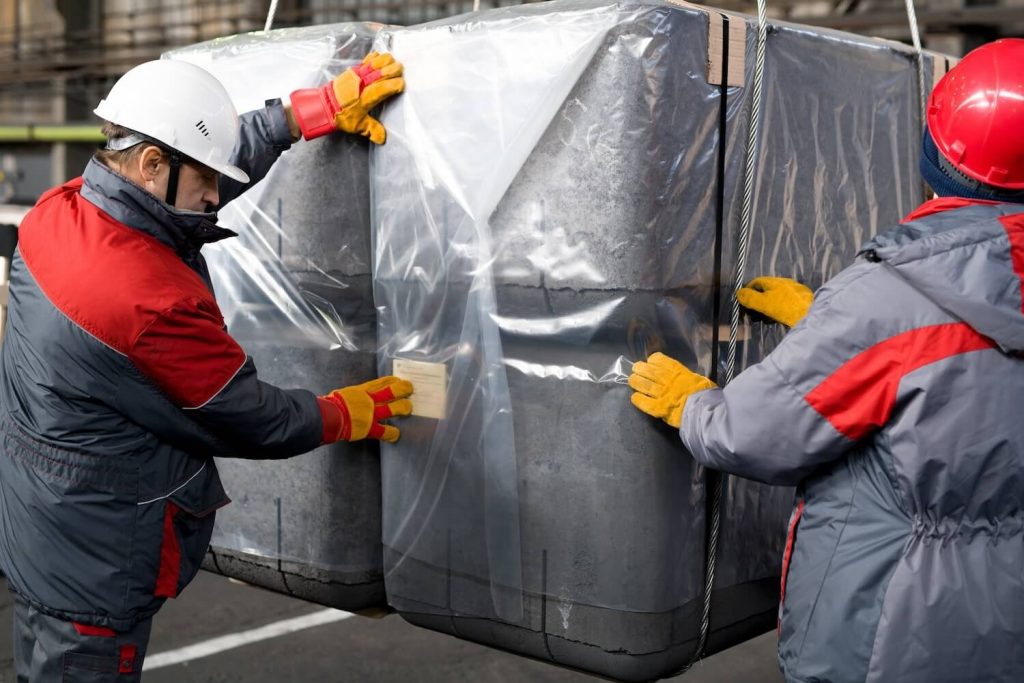
When a piece of FAB equipment leaves its Class 10 or Class 100 environment, it enters a world of chaos. To a lithography machine, a single flake of skin or a speck of Albuquerque dust is a “boulder” that can ruin a wafer. Wafer fab relocation experts utilize a rigorous layering process:
- The Anti-Static Layer: The first wrap is a specialized ESD-safe film. This prevents the buildup of static electricity that can fry delicate circuitry during the friction of transport.
- The Nitrogen Purge: Before the second layer is sealed, the air is replaced with ultra-high-purity nitrogen. This displaces oxygen and moisture, preventing oxidation and internal condensation.
- The Moisture Barrier (Mylar): A heavy-duty, heat-sealed foil layer acts as a vapor barrier. This is critical when moving equipment through varying altitudes in New Mexico, where pressure changes can “suck” moist air into unsealed crates.
- The Physical Shroud: Finally, a thick outer layer protects against physical punctures and ensures the equipment remains “cleanroom ready” upon arrival, allowing for a faster move-in through the gray space.
What is “Soft-Touch” rigging, and why is it necessary for lithography?
“Soft-Touch” rigging utilizes specialized air pallets (air casters) and vibration-dampening tools to move heavy, sensitive machinery without the jarring impact of traditional forklifts or rollers.
In industrial rigging in Albuquerque, the greatest danger isn’t the weight, it’s the vibration. A standard nylon roller on a concrete floor creates “micro-shocks” that can knock mirrors out of alignment or cause hairline fractures in ceramic components.
JCS employs Air Caster Technology. Imagine a several-ton machine floating on a thin film of air, much like a giant air-hockey puck.
- Zero-Vibration Transit: Because there is no mechanical contact with the floor, vibration is virtually eliminated.
- Omni-Directional Movement: Our riggers can pivot a massive tool 360 degrees in a space with only inches of clearance.
- Floor Preservation: Cleanroom floors are often coated with specialized, expensive epoxy. Air casters distribute the weight so evenly that the floor remains pristine, preventing “outgassing” from cracked surfaces.
How does climate-stabilized transit prevent equipment “Shock”?
Climate-stabilized transit involves the use of specialized trailers equipped with redundant HVAC systems and air-ride suspension to maintain a precise temperature and humidity range, regardless of the outdoor weather in New Mexico.
Albuquerque’s climate is a study in extremes. A truck departing a facility in the North Valley at noon might face 90-degree heat and 10% humidity. By the time it climbs toward the mountains or heads toward a shipping port, those conditions shift radically.
Tech manufacturing moves fail when “The Cold Soak” occurs. If a machine’s internal temperature drops during a night move and then encounters warm air during unloading, condensation forms instantly on the coldest internal parts, usually the optics or the motherboard.
JCS utilizes active climate control:
- Redundant HVAC: Our trailers don’t just “insulate”; they actively refrigerate or heat to maintain a set point (typically 20°C ± 2°C).
- Air-Ride Suspension: Specialized trailers use oversized air bladders to neutralize the bumps of I-25, ensuring the “G-force” stay within the OEM’s strict tolerances.
- Remote Telemetry: Our dashboards allow you to see the humidity and temperature inside the trailer in real-time from your office.
The “Single Point of Contact” Philosophy: Solving the Facility Manager’s Burden
Most logistics failures happen in the “gaps” between vendors. The rigger thinks the crating company secured the internal brackets; the driver thinks the rigger checked the tie-downs.
At Johnson Commercial Solutions, we eliminate the gaps. We provide a single point of contact. This isn’t just a project manager; it’s a technical lead who oversees the entire lifecycle of the move. When you have a dashboard that shows the GPS location, the internal temperature of the crate, and the scheduled arrival time all in one place, the “frustrations” of logistics vanish. You are no longer managing a move; you are overseeing a successful transition.
What’s Included in JCS’s White-Glove Semiconductor Services?
We don’t just move boxes. We move the future of your production line. Our capabilities are engineered specifically for the cleanroom logistics NM market.
Our Real-World Capabilities:
- Cleanroom-Certified Teams: Our technicians are trained in Class 1 to Class 10,000 protocols. They know how to gown up, how to wipe down, and how to behave in an active FAB.
- Pre-Move Engineering Surveys: We use 3D modeling and floor-load calculations to ensure the path from the bay to the dock can support the weight.
- Custom Crating: We build “floating” crates with internal shock-absorption systems designed for specific OEM tools (ASML, Applied Materials, Lam Research, etc.).
- De-installation Assistance: We work side-by-side with your engineers to ensure all umbilical lines (gas, water, power) are safely disconnected and capped.
- Rigging of Multi-Million Dollar Tools: Using stainless steel jacks, aluminum gantries, and non-marking air casters.
- Post-Move Leveling: Ensuring the tool is perfectly positioned on its new pedestals for faster calibration.
Frequently Asked Questions
1. How do you manage the “High Altitude” pressure changes in Albuquerque?
When moving equipment from the altitude of Albuquerque (5,312 ft) to sea-level ports, pressure differentials can affect sealed components. We utilize pressure-relief valves or “breather” desiccant systems that allow the crate to equalize pressure without letting in moisture or contaminants.
2. Can you move equipment through “Active” FAB areas?
Absolutely. We specialize in “Live-Site” logistics. We use localized HEPA filtration (shrouds) and non-off-gassing materials to ensure that moving a tool in Bay 4 doesn’t contaminate the wafers currently being processed in Bay 5.
3. What is the biggest risk during a wafer fab relocation?
Human error during the “hand-off.” Most damage occurs when equipment is being moved from the rigging floor to the transport trailer. Our integrated “Soft-Touch” protocol ensures the machine never experiences a jarring drop or a “hard” connection.
4. Do you provide real-time tracking for international moves?
Yes. For equipment heading from Albuquerque to global sites (Ireland, Israel, Taiwan), we provide end-to-end visibility. Our sensors track GPS, temperature, humidity, and “Shock/Impact” events, uploading data to your dashboard via satellite.
5. How do you handle the specialized epoxy floors found in most Albuquerque FABs?
We use only non-marking, high-density polyethylene (HDPE) floor protection or air casters. This ensures that we never leave a scratch, scuff, or crack in your cleanroom floor.
6. Are your riggers trained for specific OEM requirements?
Our teams are familiar with the handling requirements for major semiconductor OEMs. We often work directly with the OEM’s onsite installation engineers to ensure that every “red tag” and shipping bracket is installed exactly to factory specs.
7. What happens if a move is delayed by weather?
Our Albuquerque warehouse is a climate-controlled, secure storage facility. If a site isn’t ready or weather prevents safe transport, your equipment stays in a stabilized environment that mirrors its home FAB, not a dusty “standard” warehouse.
A New Way Forward for Your Manufacturing Facility
The days of white-knuckle moves are over. Imagine the relief of a relocation project where the most difficult thing you have to do is check a dashboard. No phone tag with drivers. No cleanroom contamination scares. Just a perfectly executed transition that keeps your FAB throughput on schedule.
At Johnson Commercial Solutions, we don’t just see the machine; we see the months of research and the millions of dollars in potential revenue it represents. We are here to be the steady hand that guides your most sensitive assets to their next destination.
Protect your FAB throughput. Partner with Johnson Commercial Solutions Albuquerque for high-tech industrial relocation.
